

How To Repair Wall Damage
If y'all notice yourself staring at damaged walls and ceilings in your home, it might be fourth dimension for a little TLC and an update. The interiors of near homes are covered with gypsum wallboard, which is commonly known every bit drywall, or by its trade name, Sheetrock. Drywall is durable to a degree, but information technology tin can merely take and then much before you beginning to see holes, cracks, and dents—peculiarly if you've got toddlers or pets running around.
⚒️ Yous like fixing stuff. So do we. Let's DIY some cool $h*t together.
Fortunately, most drywall impairment can exist repaired quickly and easily. All you need are some basic tools, the right materials, and a few tricks of the trade. This step-past-step DIY guide volition prove you how to repair drywall—from doorknob damage, to cracks under the window, all the way to saggy ceilings—but first, we demand to go over some safety measures.
⚒️ Tips To Stay Safe While You Repair Drywall
1) Lift Carefully. When patching extensive damage, it'south best to purchase total 4-by-eight human foot sheets of drywall, and then cutting them down to size as needed. But, exist brash that a full canvass of standard 1/two-inch drywall weighs almost 54 pounds.
Drywall sheets are awkward to lift and deport, so you'll want to avoid straining your dorsum. If possible, always work with a helper and call up to lift with your knees, not your back. Also, be careful when leaning drywall sheets against stuff. If a canvas should fall over, it could severely hurt someone, particularly a kid or pet.
ii) Empty Bucket Warning. Premixed joint compound comes in various size buckets, which are handy to use around the house and yard once they're empty. However, v-gallon buckets pose a serious threat to toddlers. The buckets are simply the right height that if a small child leans over the edge, they can tumble in headfirst and notice themselves unable to scramble out. Therefore, if you lot use the bucket for carrying water, never get out the bucket unattended, even if it'south holding only a few inches of water. And, never leave buckets outdoors where they can fill up with rainwater, creating a potential drowning gamble.
If you use the buckets primarily for carrying and storing tools, gardening supplies, and other dry out goods, eliminate the possibility of a child drowning by drilling drainage holes through the side and lesser of the bucket.
iii) Clean Up the Grit. Making drywall repairs typically requires sanding joint compound to produce a smooth, unblemished surface. However, joint compound grit is a respiratory irritant that contains super-fine gypsum and silica particulates. When sanding joint compound, ever wear a grit mask, or better yet, a dual-cartridge respirator, to protect your lungs.
It's also a practiced idea to spread a drop fabric on the flooring where you're sanding. When done sanding, wipe the dust off the drop cloth with a clammy sponge, so clean the surrounding areas with a shop vacuum fitted with a HEPA filter. One time the air has settled, finish up by vacuuming. This two-step cleaning is necessary because almost household vacuums can't capture super-fine sanding grit, and volition only blow it back into the air.
⚒️ Know What Compound You Demand
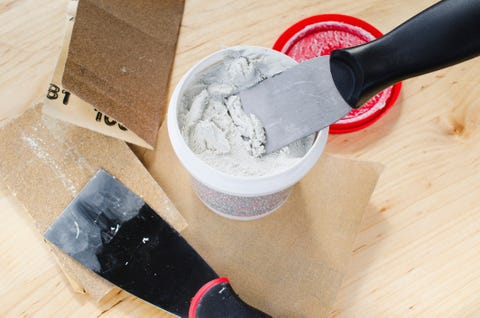
The two most common types of premixed drywall compounds—too known equally spackle—are lightweight and all-purpose. The lightweight product weighs about ane-tertiary less than all-purpose, it dries more speedily, and takes less try to sand smooth. All-purpose chemical compound dries harder and typically costs less.
Both types are piece of cake to apply and have a shelf life at room temperature of most nine months. If you have drywall damage in several rooms, buy a v-gallon bucket of compound. For smaller repairs, something like this will suffice.
Note that dry out-mix joint compound is also available, which comes in pulverisation course. Information technology must be mixed with water to the proper consistency prior to application. Dry-mix chemical compound is more affordable than the pre-mixed varieties, but pre-mix compound is easier and quicker to utilize for DIY repairs.
⚒️ Problem i: Doorknob Harm
Step 1: One of the near common drywall repairs occurs when a door is swung open up a piffling as well forcefully and the doorknob punches a pigsty through the drywall. The simplest style to gear up the hole is with a peel-and-stick repair patch. The patch consists of an agglutinative-backed aluminum screen that'due south reinforced by fiberglass mesh. Simply peel off the protective backing and press the patch over the pigsty.
Step 2: Utilise a four- or six-inch-broad drywall pocketknife to apply joint compound over the patch. Be sure to apply enough pressure level to force the chemical compound through the mesh. After the chemical compound dries, sand lightly and apply a second, thinner coat of compound, making sure to extend it a few inches beyond the offset coat. Repeat a third and final fourth dimension. When dry out, sand lightly, and so prime and paint.
⚒️ Trouble ii: Crumpled Corner Dewdrop
Footstep 1: When two sheets of drywall see at an exterior wall corner, they're protected by an Fifty-shaped metal strip chosen a corner bead. Corner bead is nailed over the corner and then concealed past ii or 3 layers of joint compound. Metallic corner bead is pretty tough stuff, just it's not indestructible. Information technology tin get dented through any number of activities, including run-ins with the vacuum cleaner, a kid flinging a toy, or when moving furniture. The adept news is that, unremarkably, merely a small section of the corner bead gets damaged, making the repair much simpler.
Brainstorm by using a hacksaw to cut through the corner bead approximately two inches above and below the damaged section. Next, take a utility pocketknife and cut along each vertical edge of the corner bead, making sure you piece through the paint and articulation chemical compound.
Step two: Pry the severed piece of corner bead from the wall using a thin pry bar and direct-bract screwdriver. Try not to damage the surrounding drywall surfaces. Now, use aviation snip to cutting a new piece of corner bead to replace the damaged department.
Pace three: Set the new piece into place and fasten it with 1½-inch-long drywall nails, which have very thin, flat heads that are easier to muffle with articulation chemical compound than drywall screws.
Step 4: Utilise two to three coats of joint compound, making certain to sand between coats. Spread the terminal glaze with an eight-inch drywall knife. When done, prime and paint to match the walls.
⚒️ Problem 3: Creeping Cracks
Step 1: Vertical drywall cracks will oftentimes appear higher up and below windows and doors. These hairline cracks are usually caused by lumber shrinkage and settling in the house frame. To repair the cracks, start by using a sanding sponge to sand the scissure smooth. Later on sanding, vacuum the crack to remove all loose grit and debris.
Step 2: Side by side, use a narrow putty pocketknife to utilize a sparse coat of articulation chemical compound to the scissure. Wait for it to dry, then sand it smooth. Repeat, applying a second thin glaze.
Stride three: To dissuade the crack from reappearing, spray the repair with a sparse coating of elastic cleft encompass-up, such as Good-Bye Cracks.
⚒️ Problem iv: Nails That Get Pop
Step 1: Nail and spiral pops are also caused by lumber shrinkage. To fix a popped blast or screw, kickoff past twisting the tip of a utility pocketknife into the wall to carve away the articulation compound from the fastener head.
Step 2: Use a screwdriver to tighten the screw, driving it well beneath the surface. If it'due south a popped nail, use a hammer and nail set up to tap it in deeper. If it feels as if the blast isn't hitting solid wood, yank it out with pliers and drive in a drywall screw, making sure y'all hit the center of the wall stud or ceiling joist.
Pace 3: Hibernate the repair using a drywall pocketknife to utilize three sparse coats of lightweight articulation compound. Sand between coats, and then prime and pigment.
⚒️ Problem v: Saggy Textured Ceilings
Pace 1: Water harm will usually stain a drywall ceiling, but in some farthermost cases, the drywall will actually sag downwardly from the joists. This is a especially catchy repair on a textured ceiling. Start by using a manus-sanding pad equipped with a sanding screen to remove the texture and polish out the surface area.
Stride 2: Next, press the drywall up tight against the joist and secure it along the seam with drywall nails or screws driven into the center of the joist.
Stride iii: Water stains volition oftentimes bleed through standard primer. To foreclose the stains from reappearing, brush on a coat of primer that is specifically formulated to block out the toughest stains.
Pace four: To blend in the repaired area with the surrounding textured ceiling, use a thick-nap roller to apply a thick mixture of drywall compound, thinned with a little water.
Step five: Before the thinned drywall compound dries, add texture to the ceiling with a short-handled brush. If your ceiling has a popcorn texture, endeavour concealing the repair with popcorn texture in a spray can.
⚒️ Problem vi: Loose Inside-Corner Tape
Stride 1: Seams betwixt sheets of drywall are subconscious backside paper drywall record and several sparse layers of joint compound. Occasionally, the newspaper tape will pull loose and peel up, particularly in bathrooms where the tape is repeatedly exposed to hot, moist air. And this problem often occurs at inside wall corners.
While information technology's tempting to merely mucilage down loose tape, it's all-time to cut it out with a utility knife and replace information technology with a new piece of record. Later on cutting away the loose tape, apply a thin bed of drywall compound to each wall in the corner.
Footstep 2: Adjacent, cut a new piece of paper tape to length, fold it lengthwise along its centre crease, and press it into the wet joint compound.
Footstep 3: You can press the tape into the compound and shine information technology out with a four-inch knife, simply using an inside-corner knife makes the job much easier. This specialty tool smooths both sides of the inside corner at the same time.
⚒️ Trouble 7: Patching Large Holes
Stride ane: To repair a large hole in drywall, showtime draw a square outline around the pigsty using a 24-inch level. As you marker the iv lines, be sure to center one vertical line on the heart of a wall stud.
Pace ii: Cut three sides of the square using a drywall saw, which is also called a jab saw because you commencement cutting by jabbing the saw's pointed tip through the drywall. Lift away the debris as yous cutting to continue it from falling into the wall cavity.
Step three: Remove the drywall on the remaining side of the outline past using a utility knife to cut down the eye of the stud.
Step four: Cutting a one-by-four pes pino lath vi to viii inches longer than the foursquare opening in the wall. Squeeze some construction adhesive onto the ends of the board.
Step 5: Sideslip the one-by-4 into the hole with the glued surface facing the back of the drywall. Position the lath and then it extends into the opening by at least 1½ inches. Secure the board with two clamps.
Step 6: Later the agglutinative dries, cut a drywall patch to loosely fit into the pigsty. Apply some construction agglutinative to the exposed surface of the 1-past-four, then printing the patch into identify and secure it to the stud and to the one-by-four backing board with 1¼-inch drywall screws.
Step seven: Wipe down the wall and drywall patch with a slightly dampened sponge to remove whatsoever dust. Side by side, apply adhesive-backed fiberglass mesh drywall tape over the iv seams of the patch. Overlap the record at the corners for maximum strength, and eye each piece directly over a seam. Firmly press down the tape for good adhesion.
Step 8: Use a iv-inch drywall knife to apply the kickoff layer of joint compound over the tape. Allow the chemical compound to dry out overnight.
Footstep 9: Polish the stale compound with a hand-sanding pad fitted with a sanding screen.
Step x: Use an 8-inch knife to apply several skim coats of articulation compound over the repair, making each one slightly larger than the preceding one. Sand the terminal coat smooth with 220-dust sandpaper. Finish by rolling on a coat of primer, followed by ii topcoats of paint. And note that, in some cases, information technology might be necessary to pigment the entire wall to ensure the patch is undetectable.
This content is created and maintained past a 3rd party, and imported onto this folio to help users provide their email addresses. Y'all may exist able to find more information about this and similar content at piano.io

How To Repair Wall Damage,
Source: https://www.popularmechanics.com/home/interior-projects/how-to/a185/easy-drywall-repair/
Posted by: mckinleybleall.blogspot.com
0 Response to "How To Repair Wall Damage"
Post a Comment